
Kunjungan Hari Ini20
Pengunjung Hari Ini18
Total Kunjungan4,771
Total Pengunjung4,127
Pengunjung Online0
ZA
Zeffa Aprilasani
Independent Researcher
AIM
Adis Imam Munandar
Independent Researcher
Energy Security
PLN
Coal Transition
PLN
Coal Transition
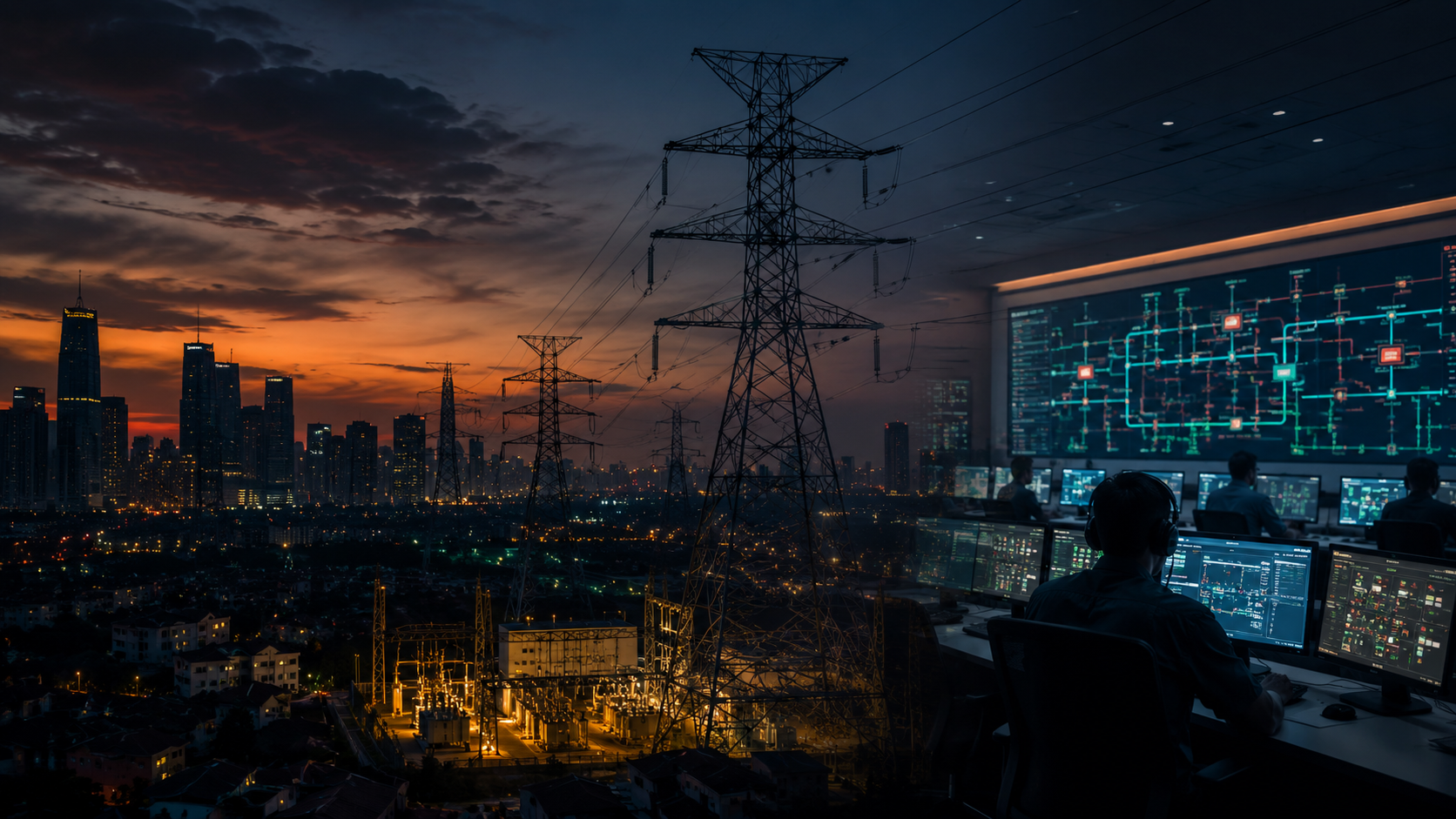
On May 22, 2026, large parts of Sumatra lost power after a disturbance on the 275 kilovolt (kV) Muara Bungo-Sungai Rumbai transmission line in Jambi triggered a cascading grid failure, according to PLN. Around 13.1 million PLN customers were affected, about 5,334 MW of electricity supply was disrupted, and at least four people reportedly died from suspected carbon monoxide poisoning while using generators.
PLN President Director Darmawan Prasodjo attributed the fault to lightning and tree-felling near the transmission corridor. PLN and the national police (Polri) stated their initial investigation found no indication of sabotage.
The Sumatra blackout fits a recurring pattern in Indonesian electricity history. The question now is not whether the grid needs structural reform, it is how fast that reform can happen before the next failure.
Infographic 1 of 4
The Recovery Clock: From Blackout to (Partial) Restoration
MAY 22, 2026 · 6:44 PM WIB
Large Parts of Sumatra Lost Power
13.1M
customers
lost power
5,334 MW
supply cut at 6:44 PM, about half of Sumatra’s peak demand
48+ hrs
PLN reported North Sumatra largely restored by May 24-25
~2-3 wks
PLN’s estimated timeline for full restoration in North Sumatra
4
reported deaths from suspected generator CO poisoning
176 + 543
main + distribution substations taken offline
Source: PLN · Jakarta Globe · Kompas.id · Liputan6 · InfoPublik, 2026
A textbook blackout spiral: grid protection systems tripped plant after plant as frequency collapsed across several provinces, including Jambi, West Sumatra, Riau, North Sumatra, and Aceh
I. The Sumatra Blackout: What Happened
A cascading failure, an official explanation that didn’t hold up, and a human toll that went far beyond inconvenience
According to PLN, 176 main substations and 543 distribution substations were taken offline. The cascading shutdown was technically automatic: grid protection systems tripped power plants to prevent equipment damage when frequency collapsed, which caused further supply loss, which triggered more shutdowns, a textbook blackout spiral.
PLN’s explanation drew public skepticism, with commentators questioning whether weather alone could account for a failure of this scale on a single transmission corridor serving millions of people.
The Human and Economic Toll
The losses extended far beyond inconvenience. Telecommunications networks went down across most of the affected region. Gas stations closed, creating long queues at those that stayed open using generators. Hospitals switched to backup power. Traffic lights failed simultaneously across Pekanbaru, Padang, and Medan, creating gridlock during the Friday evening rush. Factories halted production. Poultry died on farms without ventilation. Fish floated dead in aquaculture ponds as oxygen pumps stopped.
Small businesses had no generator backup, meaning direct revenue loss for every hour of darkness. Industrial operations that do have diesel generators found them increasingly costly to run amid elevated global oil prices through early 2026. Two days of disruption to Sumatra’s manufacturing and trade corridors likely cost billions of rupiah in GDP terms.
A recovery that stretched into June
PLN estimated full restoration in North Sumatra would take until around June 10, more than two weeks after the initial failure, underscoring how a single transmission fault can take weeks, not days, to fully resolve across an interconnected grid.
II. This Was Not a Freak Accident
A recurring pattern, a structural vulnerability, and an uncomfortable question about sabotage
The May 2026 Sumatra blackout fits a recurring pattern in Indonesian electricity history. Indonesia experienced a Java-Bali blackout in 2005 that cut power to tens of millions for several hours. Java suffered a massive outage in 2019. The Sumatra grid has been flagged as structurally vulnerable for years due to its single-corridor topology: electricity generated in the south feeds the north via a limited number of transmission pathways, creating a single point of failure that this incident exposed completely.
Infographic 2 of 4
Structural Vulnerability vs. Modern Grid Standards
WHY THE GRID FAILED THIS WAY
Linear Topology vs. N-1 Security Standard
Sumatra’s Reality
Single-corridor topology
South-generated power feeds the north via limited transmission pathways, one point of failure for tens of millions of people.
No redundancy on critical corridors
A single fault on a long-distance line can black out an entire region with no backup pathway.
Predictable, not surprising
“It was a matter of when, not if”, engineers had flagged this in PLN’s own infrastructure reports.
N-1 Security Standard
Survive any single-element loss
Modern grid design requires stability even after losing any single transmission line or generator.
Cross-linked architecture
Multiple interconnected pathways isolate faults instead of letting them cascade region-wide.
Sumatra’s gap
Sumatra’s most critical corridors do not meet this standard, the May 22 cascade is the direct consequence.
Source: Deputy Minister Yuliot Tanjung · IEA · PLN infrastructure reports, 2026
A textbook case of structural lock-in meeting a grid that has not been redesigned for the standards it claims to follow
The question of sabotage: legitimate concern or alarmism?
In the context of escalating geopolitical tensions globally, including conflict in the Middle East and US-China friction in the Indo-Pacific, some commentators raised the question of whether the blackout might have involved deliberate infrastructure interference. PLN and Indonesian police (Polri) stated their initial investigation found no indication of sabotage, pointing instead to lightning and vegetation encroachment on the transmission right-of-way as the likely proximate cause.
Whether this particular blackout was purely technical or not, it demonstrates that the grid is vulnerable to disruption, by accident or by design. Ukraine’s power grid was systematically attacked via cyberattack in 2015 and again through physical strikes in 2022, a reminder that critical electricity infrastructure is increasingly viewed as a strategic asset worth protecting against both natural and deliberate threats.
Not Just Sumatra: Java’s Own Pattern of Outages
If the Sumatra blackout were an isolated event, it might be easier to dismiss as a one-off failure on an unusually exposed corridor. But reporting from June 2026 indicates the reliability problem extends well beyond Sumatra. Jakarta itself experienced two separate blackouts within a single month in early 2026: on April 9, a fault at several substations cut power across Central, North, and West Jakarta, disrupted MRT operations, and trapped some residents in elevators, with PLN reporting full restoration by around 8 p.m. the same evening. A second, separate outage hit Jakarta again on April 23, affecting areas including Thamrin, Bendungan Hilir, Kuningan, Jagakarsa, Tebet, and parts of East Jakarta, prompting Indonesia’s Energy and Mineral Resources Ministry to dispatch a team to work with PLN on identifying the cause.
By early-to-mid June 2026, reporting describes a broader pattern of repeated outages across multiple regions of Java in the same window as the prolonged North Sumatra recovery. According to a Jakarta Post/Asia News Network report published June 12, 2026, power outages in recent days had also been reported in Bekasi, Sukabumi, Bogor, and Tasikmalaya in West Java; in Semarang, Tegal, Boyolali, and Wonogiri in Central Java; and in Yogyakarta. The same report ties these outages to concrete disruptions: in Sukabumi, a fifth-grade student’s online national science olympiad exam was interrupted mid-test by a power cut, and in Cileungsi, Bogor, a five-hour outage caused a resident’s aquarium aeration system to fail, killing several fish. In North Sumatra, separately, a storm that brought down 12 transmission towers cut power from June 4, with PLN initially estimating restoration by around June 10, and the same outage reportedly damaged equipment at regional water utility PDAM Tirtanadi, raising a secondary risk to clean water supply.
A pattern, not an anomaly, recent outages at a glance
Apr 9, 2026, Jakarta: Substation fault, Central/North/West Jakarta, MRT disrupted, restored same evening
Apr 23, 2026, Jakarta: Second blackout in a month, multiple districts, cause under ministry-PLN review
May 22, 2026, Sumatra: 275kV Jambi line fault, ~13.1M customers, multi-day recovery
Jun 4-10, 2026, North Sumatra: Storm felled 12 transmission towers; water utility equipment damaged
Early Jun 2026, West & Central Java: Bekasi, Sukabumi, Bogor, Tasikmalaya, Semarang, Tegal, Boyolali, Wonogiri, Yogyakarta all report outages
Net effect: Disrupted exams, damaged equipment, water-supply risk, reliability concerns are now nationwide, not Sumatra-specific
Source: The Jakarta Post / Asia News Network, June 12, 2026 · Tempo, April 2026 · Antara, April 2026
None of these Java incidents individually approaches the scale of the Sumatra blackout, most were localized, lasted hours rather than days, and affected thousands rather than millions of customers. But taken together, they shift the framing of the Sumatra event from “an exceptional failure on a uniquely vulnerable island grid” to “the most severe recent manifestation of a reliability problem that recurs, in smaller forms, across the national grid.” That reframing matters for policy: it suggests the structural reforms discussed below are not a Sumatra-specific fix, but a national one.
III. Why Energy Security Matters More Than Ever
Six dimensions of energy security that Indonesia must confront simultaneously
The Sumatra blackout is a local event with global implications. It reveals the intersection of six critical dimensions of energy security.
Economic Continuity
Electricity as GDP backbone
A 48-hour blackout across a major island economy is not an inconvenience, it’s a GDP event. Nickel downstreaming and EV battery investment only raise the reliability bar.
National Security
Grid as strategic target
Military, intelligence, and early-warning systems depend on grid reliability. The blackout knocked out telecoms simultaneously, a dual failure with serious implications.
Geopolitical Exposure
Middle East tensions and oil price volatility
Renewed Middle East tensions and threats around the Strait of Hormuz in early 2026 pushed global crude prices sharply higher, a reminder that Indonesia’s energy supply chain runs through contested geography.
Social Stability
The political cost of darkness
Four deaths and rolling blackouts weeks later have generated deep public anger. Compensation demands cite Law No. 30/2009 on Electricity.
Investment Climate
Foreign direct investment signal
Data center operators typically require uptime guarantees in the 99.9%+ range. A multi-day, multi-province blackout sends a damaging reliability signal to this category of investor in particular.
Climate Transition
The coal reliability paradox
Coal dominates partly because it’s seen as “reliable.” This blackout challenges that, distributed renewables plus storage could improve resilience, not reduce it.
IV. Indonesia’s Energy Outlook 2026 and Beyond
An energy mix locked into coal, a JETP that hasn’t delivered, and a renewable potential barely touched
Indonesia is the world’s largest coal exporter and the fourth most populous country, with energy demand growing consistently as the economy industrializes. The current energy mix remains heavily skewed toward fossil fuels: renewables made up roughly 15% of primary energy supply in 2024, while coal alone accounted for around 40% of primary energy and was the dominant source of electricity generation, with fossil fuels overall supplying the large majority of power generated. Government targets for renewables by 2030 have shifted over time and are generally discussed in the 19-23% range, depending on the scenario.
Infographic 3 of 4
Energy Mix Reality vs. Renewable Potential
PRIMARY ENERGY MIX, 2024
Where Indonesia’s Power Comes From
Primary Energy Supply, 100%
Coal, 40% Crude oil & petroleum, 29% Natural gas, 16% New & renewable, 15%
Zooming into Electricity Generation
0.5%
Solar + wind = 0.5% of electricity
vs. global average 15%, Philippines 2.9%, Thailand 4.4%. Indonesia ranks among the world’s lowest despite leading solar irradiance.
Solar Potential vs. Actual Use
Total potential 7,700 GW
Renewable market size, 2026 est. 18.4 GW
Just 0.24% of total potential is in use
USD 3.1B
of the USD 21.4B JETP pledge distributed/financed so far, ~14.5%
USD 34.8B
estimated savings from real coal phase-out
Source: Ember Energy, MEMR 2024 · IESR 2026 · Modern Diplomacy, April 2026
A country sitting on 7,700 GW of solar potential is using less than a quarter of one percent of it
PLN’s RUPTL 2025-2034: Ambition on paper
PLN’s National Electricity Supply Business Plan (RUPTL) 2025-2034 outlines plans for roughly 69.5 GW of total additional generating capacity, including around 42.6 GW of new and renewable energy and about 10.3 GW of battery energy storage (BESS). Under the RE Base scenario, renewable energy plus BESS is projected to reach around 34.3% of the mix by 2034. The government has also floated a more aspirational ambition of 100 GW of solar capacity, alongside a longer-term commitment to phase out fossil fuels within 10-15 years. Separately, market research estimates put Indonesia’s renewable energy market size at around 18.4 GW in 2026, up from roughly 16 GW in 2025, with projections reaching over 37 GW by 2031.
The JETP reality: promises versus disbursement
The Just Energy Transition Partnership (JETP), signed at the 2022 G20 Bali Summit, committed USD 20 billion (later raised to USD 21.4 billion after Germany replaced the departing United States) to accelerate Indonesia’s coal retirement and renewable scale-up. Three years on, the results are sobering.
Disbursement lagging far behind pledges
Of the USD 21.4 billion JETP pledge, only around USD 3.1 billion, roughly 14.5%, has been distributed or financed so far, according to reporting cited by Modern Diplomacy (April 2026). The same reporting indicates the 2025 JETP Progress Report projects fossil fuels will still supply more than half of installed capacity by 2030, with coal remaining a significant share.
The original ambition to retire 6.7 GW of coal-fired capacity by 2030 is now widely seen as unlikely to be met on schedule. The early retirement of the Cirebon-1 plant, one of JETP’s most closely watched pilot projects, has effectively stalled, with Indonesia reportedly unlikely to proceed and re-evaluating its approach. At COP30 in Brazil, no major new commitments to fund coal phase-out in Indonesia were announced.
The data center and digital economy wildcard
One of the least-discussed drivers of Indonesia’s future electricity demand is the digital economy and data center sector. Domestic data center installed capacity is expected to grow from about 1.44 GW in 2025 to 3.56 GW by 2030, more than doubling in five years. But every megawatt of data center capacity requires guaranteed uptime. The Sumatra blackout is precisely the kind of event that sends data center investors to Singapore, Malaysia, or the Philippines instead.
The coal paradox: why coal persists despite rising cost
Coal’s dominance reflects structural lock-in created by decades of coal-favoring policy, PLN’s long-term coal power purchase agreements (PPAs), and an electricity pricing regime that has historically underpriced power. The Java-Bali grid is currently oversupplied, with coal plants running at declining capacity factors. Yet fixed payments under take-or-pay PPA obligations continue to strain PLN’s finances, Indonesia is simultaneously paying for excess coal capacity it does not need while struggling to fund the renewable transition it does need.
Economically, the case against coal continues to strengthen. Global benchmark costs for utility-scale solar and onshore wind have fallen well below typical coal generation costs in recent years, narrowing the financial rationale for new coal investment. Separately, IESR and related analyses estimate a genuine coal phase-out could save Indonesia in the order of USD 34.8 billion in electricity subsidies and USD 61.3 billion in health-related costs over time, figures that, if directionally correct, would dwarf the value of stranded coal assets. As one observer summarized it, the barrier to Indonesia’s energy transition is increasingly political and financial rather than technical.
V. Three Structural Reforms Indonesia Cannot Defer
Grid modernization, realistic coal transition financing, and distributed renewables
1. Grid modernization and inter-island interconnection
The Sumatra blackout makes the case for grid investment more compellingly than any policy document. The IEA has noted that an expected Java-Bali to Sumatra interconnection by 2028 would significantly improve system resilience. PLN’s Smart Grid roadmap targets completion “by 2033 in stages”, a timeline that needs to be accelerated, not delayed. Power wheeling reform, which would allow multiple stakeholders to use PLN’s transmission infrastructure to deliver electricity from distributed generation sources to load centers, is a promising mechanism that has stalled in Indonesian regulatory debate.
2. Realistic coal transition with domestic financing anchors
Waiting for international JETP funding to finance coal retirement is no longer a viable strategy. With the United States having withdrawn from its earlier commitment and only around USD 3.1 billion of the USD 21.4 billion pledge distributed or financed so far, Indonesia needs a domestic financing architecture for energy transition. Carbon pricing, green sukuk, and state budget allocation for early retirement packages need to be structured in a way that gives PLN a credible off-ramp from its coal PPA obligations without creating fiscal crisis.
3. Distributed renewable deployment and battery storage
The Sumatra blackout’s cascading failure pattern reveals the vulnerability of centralized generation connected via long linear transmission corridors. Distributed solar and battery storage deployed at substation and industrial level would provide inherent resilience: if a transmission line fails, local generation and storage can maintain critical loads independently. Indonesia’s 7,700 GW of solar potential is available on every rooftop, in every industrial park, on every island in the archipelago. The regulatory framework for behind-the-meter generation and net metering remains cumbersome and needs urgent simplification.
Infographic 4 of 4
2030 Energy Targets: The Gap Between Now and Then
SIX METRICS, ONE DEADLINE
2026 Actual vs. 2030 Target
Renewable share in energy mix
AT RISK, DELAYED
2024: 15% 2030 target: 23%
Coal share in electricity generation
STRUCTURAL LOCK-IN
~68% of generation (2024) 2030 BAU target: ~53% (marker)
Solar + wind in electricity mix
FAR BELOW GLOBAL AVG.
2024: 0.5% Global average: 15% (no formal target set)
JETP coal retirement capacity
LIKELY TO FAIL
2026: 0 GW retired 2030 target: 6.7 GW
Renewable capacity (market est.)
ACHIEVABLE
2026 est.: 18.4 GW 2030 target: 23 GW
Java-Bali ↔ Sumatra interconnection
URGENCY ELEVATED
2026: Fragmented Planned: 2028
Light marker = target line · bar = current status. Source: IEA · Ember · Modern Diplomacy · MEMR 2026
Of six key targets, four are at risk or structurally locked in, only grid interconnection has gained real urgency post-blackout
VI. The Geopolitical Dimension: Energy as Sovereignty
A coal exporter facing structural demand decline, and an oil importer exposed to every global shock
Indonesia’s energy security challenge is inseparable from its geopolitical positioning. The country is the world’s largest coal exporter, earning substantial foreign exchange from a commodity whose global demand is in long-term structural decline as importing nations transition to renewables. Several of Indonesia’s largest coal customers, particularly in Europe and increasingly in East Asia, are accelerating their own clean energy transitions. As one energy analyst noted: “Countries that consume Indonesia’s coal might be moving to renewables, so Indonesia might be losing the export market.”
This creates an uncomfortable timeline. Indonesia currently benefits from coal export revenues that help stabilize its current account and fund fiscal transfers that underwrite PLN’s subsidized tariffs. If that export revenue declines faster than the domestic energy transition can generate alternative fiscal foundations, Indonesia faces a structural fiscal and energy security problem simultaneously.
Renewed Middle East tensions in early 2026, including threats and disruptions around the Strait of Hormuz, added an acute dimension to this chronic vulnerability. As an oil-importing country with limited domestic refining capacity, Indonesia is exposed to major swings in the global oil supply chain: benchmark crude prices rose sharply through the first half of 2026 before partially retreating, a volatility pattern that elevated inflation, squeezed fiscal space, and contributed to the Pertamax fuel price adjustment that is simultaneously straining household budgets.
Conclusion: The Status Quo Has Lost Its Excuse
A blackout that removed the last defense of “reliable enough”
“The Sumatra blackout removed one excuse: that the status quo is ‘reliable enough.’ It is not. The next blackout will not wait for the next RUPTL revision, the next JETP disbursement, or the next presidential energy pledge. Indonesia’s grid, as currently architected, is a liability. The question is not whether to reform it, but how fast.” Fortasia Research, June 2026
The Sumatra blackout of May 22, 2026, remains Indonesia’s most consequential grid failure in recent memory: at least four deaths, around 13.1 million customers affected, and a recovery that stretched over days in some areas and weeks in others. But by June 2026, repeated outages in Jakarta and across West Java, Central Java, and Yogyakarta made clear that Sumatra was not an outlier, it was the most visible symptom of a reliability problem affecting the national grid as a whole. Together, these incidents form Indonesia’s most compelling argument yet for urgent, structural energy reform.
Indonesia possesses 7,700 GW of renewable potential, world-class geothermal reserves, and a growing industrial base that needs reliable, clean power to attract the investment the Prabowo administration is courting. The gap between that potential and the 0.5% solar-wind share in today’s electricity mix is not a technical problem. It is a governance, financing, and political-economy problem that has been deferred for too long.
Key takeaways from this article
- On May 22, 2026, a transmission fault in Jambi cascaded into a major blackout affecting around 13.1 million PLN customers across several Sumatran provinces, with at least 4 reported deaths and a multi-day restoration process
- The root cause points to a single-corridor grid architecture lacking N-1 redundancy, a structural vulnerability flagged for years
- Full restoration in North Sumatra reportedly took roughly two to three weeks, illustrating how slowly an interconnected grid can recover from a single fault
- Indonesia uses only a small fraction of its estimated 7,700 GW solar potential; solar+wind is around 0.5% of the electricity mix vs. roughly 15% global average
- Only around 14.5% of the USD 21.4B JETP pledge has been distributed or financed so far; coal retirement targets are widely seen as unlikely to be met on schedule
- Three deferred reforms, grid interconnection, domestic coal-transition financing, and distributed renewables, are now urgent, not optional
Tag artikel:
#SumatraBlackout#JavaBlackout#PLN#EnergySecurity#CoalTransition#JETP#RenewableEnergy#GridInfrastructure #Indonesia2026
About the Authors
Zeffa Aprilasani
Zeffa Aprilasani is an independent researcher, data analyst, and writer with a Master of Science degree in Environmental Science from the University of Indonesia. Over seven years, she has supported international clients on market research, public policy, regulation, sustainability, and ESG; drawing from public databases, government sources, company reports, academic literature, financial filings, and credible media to deliver rigorous, evidence-based work.
Adis Imam Munandar
Adis Imam Munandar holds a PhD in Business Management from the School of Business, IPB University. He is active in teaching, training, and research, with interests in business management, sustainable development, public policy, economics, agentic AI, and industry studies in Indonesia.